Alcohol and Sleep: Sedation Is Not Restorative Sleep
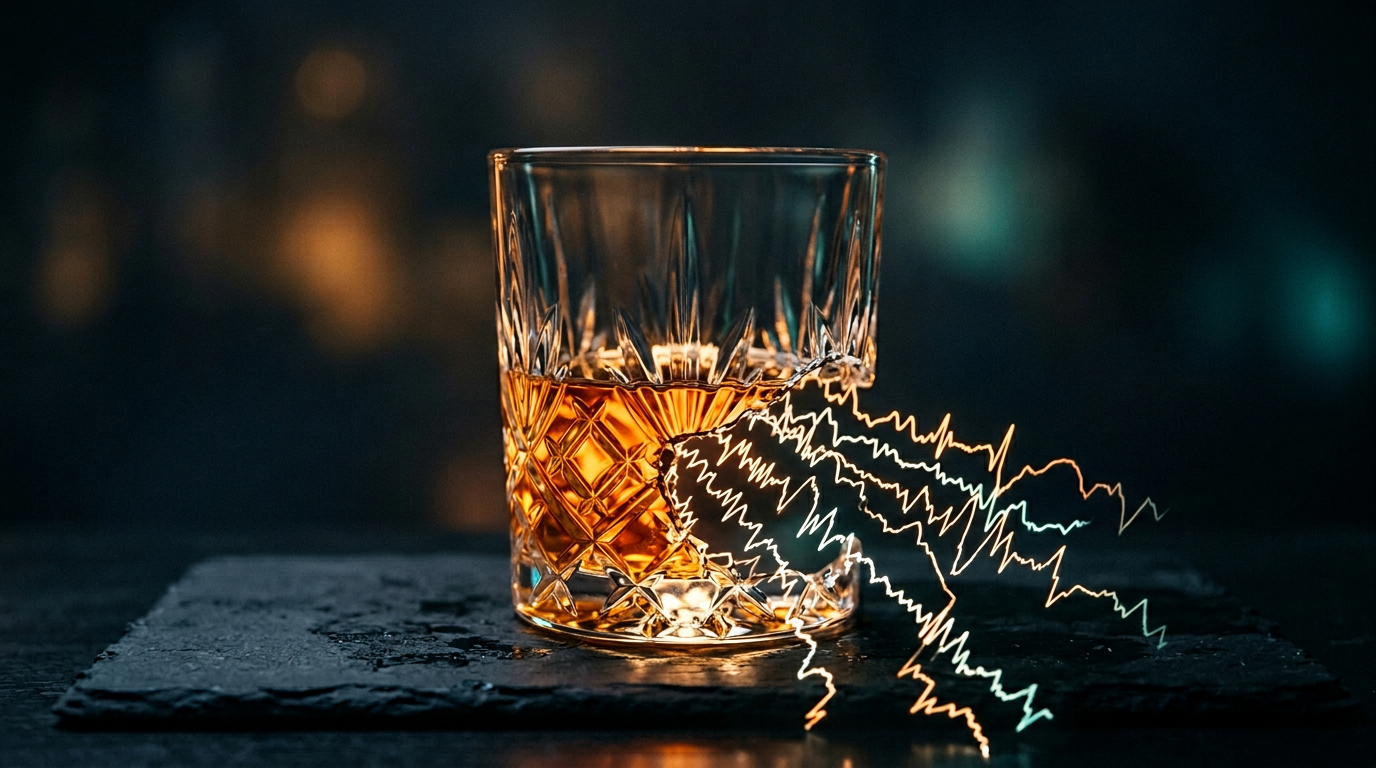
- Alcohol can shorten sleep-onset latency. That does not mean the night is restorative.
- Second-half fragmentation, REM disruption, and early awakening are the usual cost.
- In susceptible people, alcohol increases airway collapsibility and worsens AHI and oxygenation.
- Self-experiment (matched nights with/without alcohol) beats anecdote; abrupt cessation is unsafe in alcohol use disorder.
- Trackers that praise "deep sleep" after drinking are reporting labels, not architecture.
Evening alcohol often shortens the time it takes to fall asleep. That observation is frequently true. Treating faster onset as proof that alcohol "helps sleep" is the error. Sleep onset is only the start of the night; maintenance and morning restoration are separate outcomes.
Alcohol depresses the central nervous system. At enough dose it reduces arousal and can shorten sleep-onset latency. Healthy-adult laboratory work repeatedly shows quicker onset and relatively consolidated sleep early in the night.[1] If the scoreboard only counts minutes to unconsciousness, alcohol looks like a win.
Sedation is not restorative sleep. Healthy sleep is organized: non-REM and REM cycling, respiratory control, thermoregulation, memory processes, and autonomic balance. Alcohol damps arousal and rearranges that organization. Closed eyes under anesthesia are not called good sleep for the same reason.
A report that wine helps sleep is usually reporting something real. Finish the sentence: it may help sleep onset; whether it helps sleep maintenance or morning restoration is a separate measurement.
The same literature that documents faster onset documents increased disruption in the second half of the night.[1] The clinical pattern is familiar: asleep easily at 10:30, awake at 2 or 3 feeling alert, warm, thirsty, or restless. Alcohol affects autonomic activity, fluid balance, gastrointestinal symptoms, thermoregulation, and breathing; sedating effect falls as blood levels fall. The night behaves as if produced by two different nervous systems.
People remember sleep onset because they were conscious for that part. They are poor historians of brief arousals at 4 a.m. For sleep-maintenance insomnia, using an agent that eases the first two hours and destabilizes the last four can reinforce the pattern being treated.
Architecture changes as well. Alcohol tends to delay the first REM period; at moderate to higher doses, total-night REM is often reduced earlier in the night; slow-wave sleep may increase in the first half.[1] More "deep sleep" early is not a benefit if timing, sequence, and second-half stability are disrupted. Consumer trackers may report respectable deep-sleep minutes after alcohol. Stage estimates from wearables are not a substitute for the lived pattern of 2 to 4 a.m. awakenings.
For people who snore or have OSA, alcohol adds a mechanical problem. It can reduce upper-airway muscle tone and increase collapsibility. Higher alcohol consumption associates with increased sleep apnea risk;[2] polysomnography meta-analysis found alcohol raised AHI by roughly four events per hour on average and lowered nadir oxygen saturation in susceptible patients.[3] Effect size varies. Borderline or established apnea can worsen substantially on drinking nights.
For most people the first step is observation, not prohibition. Compare similar nights with and without alcohol, holding bedtime, wake time, and caffeine as stable as possible. Record sleep onset, awakenings, final wake time, and next-day function. One night proves little; a week or two is more informative. Timing and dose matter: a drink with early dinner differs from three ending at bedtime. So do age, sex, medications, liver function, and baseline sleep disorder.
Exception: alcohol use disorder, heavy daily drinking, or withdrawal risk. Do not stop abruptly as a sleep experiment. Withdrawal can be dangerous and is a different clinical problem.
Occasional drinking with good sleep does not require a complicated relationship with dinner. Reliable fast onset followed by mid-night awakening is biologically plausible and worth treating as data. Onset gets the credit. The rest of the night pays the bill.
For clinicians: deep diveMechanism, evidence, and clinical reasoning. Select to expand.
Mechanism in brief
Alcohol potentiates GABA-A signaling and reduces sleep-onset latency. As ethanol clears, relative CNS excitation and autonomic activation rise. First-half consolidation with second-half fragmentation is the expected shape, not a willpower failure.[1]
Architecture
REM delayed and often reduced early; SWS may increase early; second-half REM rebound and wake after sleep onset rise. Do not equate early SWS enrichment with restorative sleep.
OSA interaction
Simou et al. systematic review/meta-analysis: higher alcohol intake associated with increased OSA risk.[2] Burgos-Sanchez et al.: PSG meta-analysis showed mean AHI increase ~4/h and lower nadir SpO2.[3] Counsel patients with snoring, gasping, hypertension, or EDS that "I only drink to sleep" can deepen sedation while worsening respiratory events.
Counseling and self-experiment
Prefer structured observation over moralizing. Exclude AUD/withdrawal risk before any cessation trial. For insomnia maintenance phenotypes, alcohol as a sleep aid is usually counterproductive.
[1] Ebrahim IO, Shapiro CM, Williams AJ, Fenwick PB. Alcohol and sleep I: effects on normal sleep. Alcohol Clin Exp Res. 2013;37(4):539-549. doi:10.1111/acer.12006. PMID: 23347102.
[2] Simou E, Britton J, Leonardi-Bee J. Alcohol and the risk of sleep apnoea: a systematic review and meta-analysis. Sleep Med. 2018;42:38-46. doi:10.1016/j.sleep.2017.12.005. PMID: 29458744.
[3] Burgos-Sanchez C, Jones NN, Avillion M, et al. Impact of alcohol consumption on snoring and sleep apnea: a systematic review and meta-analysis. Otolaryngol Head Neck Surg. 2020;163(6):1078-1086. doi:10.1177/0194599820931087. PMID: 32513091.