Caffeine and Sleep: Timing, Dose, and the Long Tail
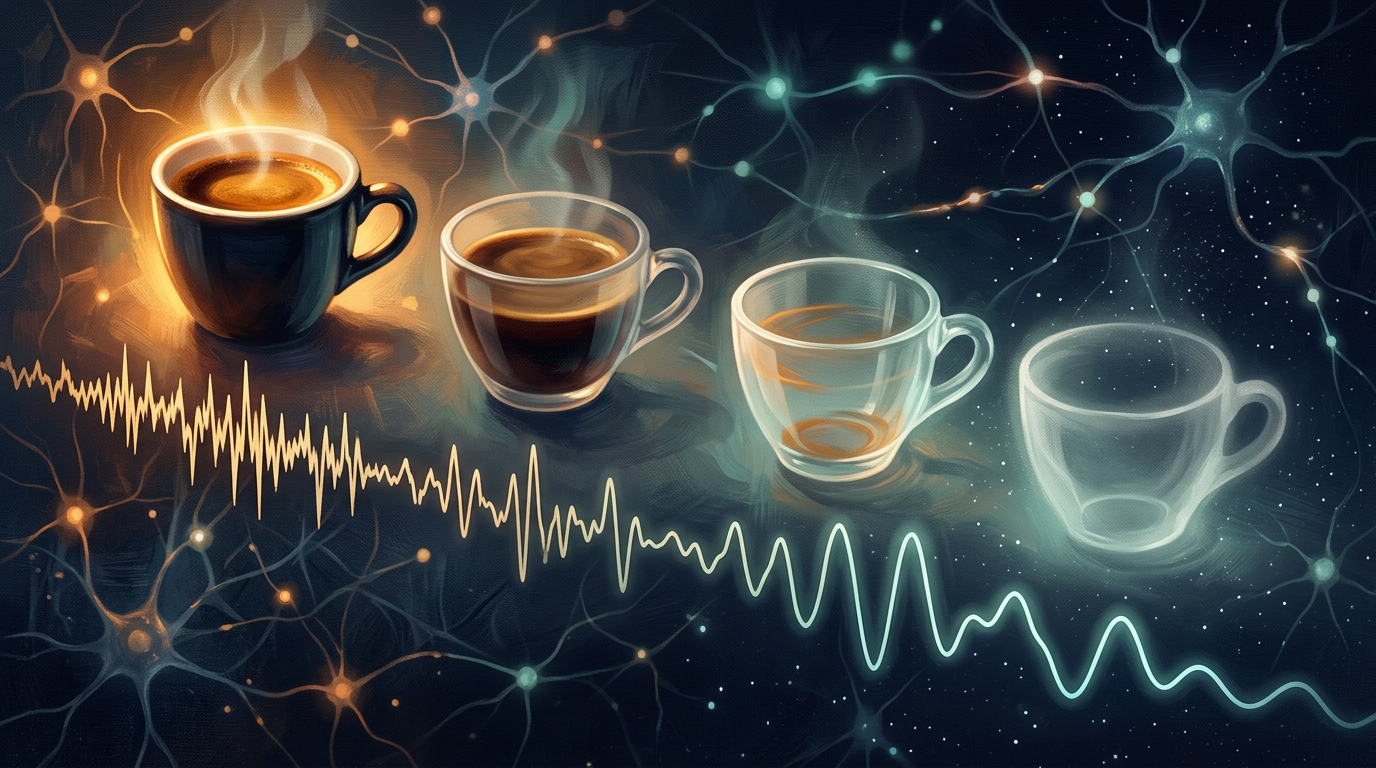
- If you have insomnia, stop caffeine; a 12-hour cutoff is the minimum guidance. Without insomnia, dose, timing, and metabolism still set how late is too late.
- Caffeine blocks adenosine signaling; it mutes the messenger, not the sleep debt.
- 400 mg even six hours before bed reduced objective total sleep time by more than 40 minutes in one controlled study.[2]
- Meta-analytic averages (~45 minutes less TST) are group estimates, not personal commandments.[3]
- Feeling able to fall asleep after late caffeine does not prove sleep architecture is intact.
People often want a single clock time to stop caffeine. Physiology does not issue one. Dose, timing, metabolism, genetics, age, habit, and baseline sleep all change the answer. "Nothing after noon" is a workable population heuristic, not a personal law. Without insomnia, the practical target is the latest hour that does not measurably harm that person's sleep. With insomnia, stop caffeine.
Caffeine works on real sleep pressure. Adenosine signaling builds with time awake. Caffeine mainly blocks adenosine receptors (especially A2A), so alertness rises even while the underlying debt remains.[1] That is useful in the morning and costly when residual blockade reaches bedtime. Caffeine does not create energy; it mutes the messenger reporting sleep need.
Afternoon caffeine can still occupy receptors at a 10:30 p.m. bedtime. Residual blockade is not a minor detail. Second-half-of-day caffeine deserves a hard look whenever sleep is fragile.
A frequently cited experiment gave healthy adults 400 mg at bedtime, three hours before bed, or six hours before bed. All three conditions disrupted sleep relative to placebo; even the six-hour dose reduced objective total sleep time by more than 40 minutes.[2] That does not oblige everyone to a six-hour cutoff. The dose was substantial. A systematic review and meta-analysis of 24 studies found caffeine reduced total sleep time by about 45 minutes on average, reduced efficiency, increased latency and wake after sleep onset, and reduced deep sleep; authors estimated a typical coffee (~107 mg) should be consumed about nine hours before bedtime to avoid a measurable TST reduction.[3]
That estimate is useful and should not become a commandment. Meta-analytic averages describe groups. They do not know CYP1A2 activity, bedtime, actual dose, or whether "one coffee" is six ounces or institutional cold brew. The defensible takeaway: caffeine can affect sleep later than most people assume.
Asking about last caffeine without asking how much is incomplete history. Small tea at 2 p.m. and a 300 mg energy drink at 2 p.m. share a timestamp and little else. Sources include coffee, espresso, tea, energy drinks, pre-workout products, some sodas, chocolate, and OTC headache preparations. People underestimate intake when they count beverages instead of milligrams. Half-life is often quoted around 5–7 hours; active methylxanthine metabolites last longer than that parent half-life. Individual variation is large (genetics, pregnancy, smoking, medications, liver function).
Sensitivity varies. Genetic differences in metabolism and adenosine signaling help explain why one person has a clear sleep response to a modest dose and another appears unaffected.[4] Tolerance to subjective stimulation does not guarantee untouched architecture. Feeling less jittery is not evidence caffeine has cleared.
Some people fall asleep quickly after late espresso. Sleep onset is one outcome among several. Caffeine can reduce TST, increase lighter sleep, decrease slow-wave sleep, increase awakenings, and alter efficiency without producing a complaint labeled "insomnia."[3] Substantial sleep debt can also overpower a dose. Falling asleep after espresso may demonstrate debt, not immunity.
Modest deterioration is hard to perceive: ten extra minutes of wake, brief arousals, slightly lighter sleep. Morning complaint becomes "I sleep enough and never feel restored." That does not convict caffeine. It makes caffeine testable.
If sleep and daytime function are good, there is little reason to manufacture a problem. If you have insomnia, stop caffeine. A 12-hour cutoff before bedtime is the minimum guidance; longer is often better because metabolites outlast the 5–7 hour parent half-life. Hold bedtime roughly constant for one to two weeks and track onset, awakenings, morning restoration, and afternoon sleepiness. People without insomnia who still want a personal experiment can trial an earlier cutoff, but insomnia itself is an indication to stop, not to shave hours off a late dose.
With chronic insomnia, stop caffeine rather than bargaining for a later cup. Also be conservative with significant anxiety, late circadian tendency, pregnancy, or medications that slow clearance. Watch the feedback loop: poor sleep leads to more caffeine, which worsens sleep.
Caffeine and sleep can coexist. The goal is to stop using caffeine as a morning rescue that quietly taxes the night.
For clinicians: deep diveMechanism, evidence, and clinical reasoning. Select to expand.
Pharmacology
Adenosine A2A antagonism explains alertness and the delayed sleep cost.[1] Document milligrams and clock time, not "cups."
Key evidence anchors
Drake et al.: 400 mg at 0/3/6 hours before bed; all disrupted sleep; six-hour dose cut TST >40 minutes.[2] Gardiner et al. meta-analysis: ~45 minutes less TST, worse efficiency/latency/WASO, less deep sleep; ~9-hour buffer estimate for ~107 mg.[3] Kapellou et al.: genetic contributors to caffeine-related brain outcomes.[4]
Counseling pattern
For insomnia: stop caffeine (12-hour cutoff minimum). For good sleepers: avoid creating orthorexia around coffee. Cross-link high-risk taper content to caffeine-tapering-and-sleep (clinical review batch) rather than duplicating taper protocols here.
[1] Urry E, Landolt HP. Adenosine, caffeine, and sleep-wake regulation: state of the science and perspectives. J Sleep Res. 2022;31(4). doi:10.1111/jsr.13597. PMID: 35575450.
[2] Drake C, Roehrs T, Shambroom J, Roth T. Caffeine effects on sleep taken 0, 3, or 6 hours before going to bed. J Clin Sleep Med. 2013;9(11):1195-1200. doi:10.5664/jcsm.3170. PMID: 24235903.
[3] Gardiner C, Weakley J, Burke LM, et al. The effect of caffeine on subsequent sleep: a systematic review and meta-analysis. Sleep Med Rev. 2023;69:101764. doi:10.1016/j.smrv.2023.101764. PMID: 36870101.
[4] Kapellou A, King A, Graham CAM, Pilic L, Mavrommatis Y. Genetics of caffeine and brain-related outcomes: a systematic review of observational studies and randomized trials. Nutr Rev. 2023;81(11):1417-1433. doi:10.1093/nutrit/nuad029. PMID: 37029915.