Sleep Performance Anxiety: Mechanism and Reset
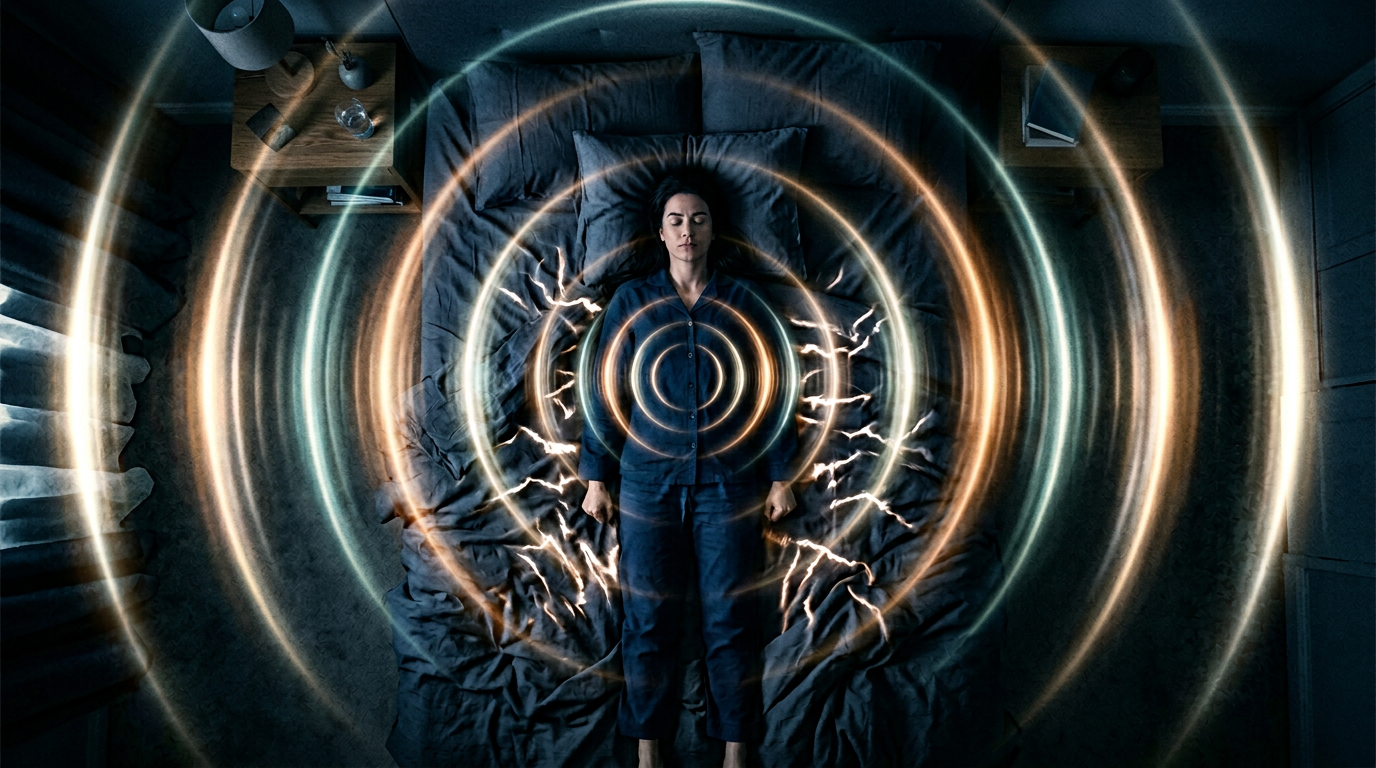
- Sleep performance anxiety is a conditioned threat response, not willpower failure. Effort worsens arousal; the goal shifts to conditions, not force.
- The loop: worry → arousal → poor sleep → more worry. Bed becomes a vigilance cue. Harder you try, more awake you feel.
- Reset strategy: wind-down 30 min prior (no work/email), leave bed if frustrated, return only drowsy. CBT-I structure rebuilds confidence over weeks.
- Short-term medication can bridge when anxiety blocks behavioral tools. Always time-limited and paired with skills training.
- Wrong move: staying in bed through frustration. Right move: interrupt the loop with a reset.
Sleep Performance Anxiety: Mechanism and Reset
Sleep performance anxiety is a learned threat response where the anticipation of poor sleep triggers physiological arousal that prevents sleep. It is not a character flaw or sign of weak resolve. The condition arises from a feedback loop: worry about sleep triggers arousal, arousal fragments sleep, poor sleep deepens the worry. Over time, bed becomes a signal for vigilance rather than rest.
Why Effort Backfires
Sleep is one of the few biological functions that does not respond to force. The harder you try to manufacture sleep, the more your nervous system interprets bedtime as a performance challenge. After a series of poor nights, your brain begins predicting another failure—and that prediction alone raises heart rate, increases muscle tension, and drives clock-checking. Effort paradoxically sustains the cycle.
The Reset Protocol
Replace the goal "make sleep happen" with "create conditions for sleep." Establish a 30-minute wind-down ritual free of work, email, and stimulating content before bed. If you find yourself awake and frustrated in bed, get up and reset—move to another room, do something low-stimulation. Return to bed only when drowsy. This breaks the association between bed and arousal.
When Medication Enters
For some patients, short-term medication can provide a window in which anxiety is low enough that behavioral tools—particularly cognitive-behavioral therapy for insomnia (CBT-I)—can take hold. This should be time-limited, monitored, and always paired with skills training. Medication without behavior change risks dependence without durable recovery.
Common Pitfalls
Many patients believe they should "stay in bed no matter what" to maintain sleep hygiene. In fact, when frustration is rising, remaining in bed reinforces the bed-as-threat association. A brief reset is more effective. Similarly, the assumption that greater willpower will overcome the problem usually increases arousal. The antidote is consistency in behavioral structure, not increased effort.
For clinicians: deep diveMechanism, evidence, and clinical reasoning. Select to expand.
Sleep performance anxiety represents a well-characterized form of conditioned arousal that emerges from the intersection of negative sleep-related beliefs, learned associations, and hyperarousal physiology. Unlike primary insomnia driven by circadian misalignment or sleep architecture pathology, sleep performance anxiety is a disorder of anticipatory threat processing—the brain treats the prospect of poor sleep (and, by extension, the bed itself) as a signal requiring vigilance.
Neurophysiological Basis
The mechanism hinges on dysregulation within classical fear-conditioning circuits. In vulnerable individuals, a series of poor nights serves as the unconditioned stimulus; bedtime becomes the conditioned stimulus. The amygdala, charged with threat detection, increasingly activates at sleep onset—triggering sympathetic mobilization, increased muscle tone, and cortical arousal. Concurrently, the prefrontal cortex (responsible for threat extinction and context evaluation) fails to adequately dampen amygdala output, particularly under conditions of fatigue and sleep loss themselves (Espie et al., 2012). The result is a paradoxical state: the body in bed, the nervous system in fight-or-flight mode.
This is further complicated by HPA-axis hyperactivity. Poor sleep itself elevates morning cortisol and reduces the normal decline across the day; anxiety about the coming night then primes the axis for additional stress reactivity, creating a self-perpetuating loop of elevated evening HPA tone and compromised sleep quality (Harvey et al., 2011).
The Paradox of Effort
A core counterintuitive principle: increased cognitive effort to fall asleep paradoxically increases cortical arousal. Broomfield and Espie (2005) demonstrated that during attempted sleep, effortful attention to sleep (including clock-checking and mental rehearsal of sleep strategies) correlates with increased wakefulness. The mechanism is straightforward—attention mobilizes the ascending reticular activating system and prefrontal networks, creating the opposite of sleep's requirements.
This observation has practical implications: instruction to "try harder to sleep" or to remain in bed "to protect sleep time" often backfires by reinforcing both the cognitive effort and the bed-as-challenge association. Patients report that the harder they concentrate on falling asleep, the more elusive it becomes.
Behavioral Reset and Conditioning Reversal
The cornerstone of treatment is stimulus-control and sleep-restriction-derived behavioral restructuring. The fundamental intervention is to weaken the bed-to-arousal association by ensuring that bed becomes paired with drowsiness and sleep, not with wakeful frustration and effort.
The protocol is straightforward: (1) establish a 30-minute wind-down period devoid of work, email, and high-engagement media—this allows cortical arousal to decline and allows homeostatic sleep pressure to build; (2) if more than 10–15 minutes of wakefulness with frustration occurs, exit the bed immediately and engage in low-stimulation activity (reading, gentle stretching) in another room until drowsiness returns; (3) return to bed only when genuinely drowsy; (4) maintain consistency across weeks to allow reconditioning.
This is not "giving up on sleep"—it is active reversal of learned arousal. Each night spent in bed while drowsy strengthens the bed-to-rest association; each exit during frustration prevents further amygdala-bed binding.
Paradoxical Intention and Advanced CBT-I
On high-anxiety nights, paradoxical intention can be effective: the patient is instructed to remain awake (without effort) and observe what happens. The removal of the goal to fall asleep often paradoxically reduces the anxiety-driven arousal, allowing sleep to emerge unforced. This works because it removes the effortful vigilance that sustains the cycle (Espie et al., 2006).
Cognitive restructuring addressing catastrophic sleep-related beliefs ("If I don't sleep, I will collapse tomorrow"; "One bad night means I have a sleep disorder") complements behavioral work. These beliefs amplify amygdala activation and should be explicitly addressed.
Role of Pharmacotherapy
Short-term medication (benzodiazepines, non-benzodiazepine hypnotics, or trazodone, depending on clinical context and contraindications) can be bridging therapy when anxiety is so high that behavioral engagement is compromised. However, medication without concurrent CBT-I training often leads to dependence or rebound insomnia upon discontinuation. The window provided by medication should be used to establish and reinforce behavioral skills—wind-down routines, stimulus control, sleep hygiene. Duration should be predetermined (typically 2–6 weeks) and tapered during CBT-I consolidation.
Timeline and Prognosis
Sleep performance anxiety does not resolve overnight. Reconditioning takes weeks—typically 3–8 weeks of consistent behavioral adherence before sleep architecture normalizes and arousal habituates. Patience and consistency are prognostic factors; patients who expect rapid resolution often abandon the protocol prematurely.
Bottom Line
Sleep performance anxiety is a treatable conditioning disorder, not a biological defect or character weakness. The pathway to recovery is reversal of learned threat associations through stimulus control, removal of effort-driven arousal, and consistent behavioral structure. When medication is deployed, it should be time-limited and paired with skills training to ensure durable recovery.
Broomfield, N. M., & Espie, C. A. (2005). Cognitive-behavioral therapy for insomnia. Sleep Medicine Clinics, 10(1), 39-45.
Espie, C. A., Broomfield, N. M., MacMahon, K. M., Macphee, L. M., & Taylor, L. M. (2006). The attention-intention-effort pathway in the development of psychophysiologic insomnia: A theoretical review. Sleep Medicine Reviews, 10(4), 215-245.
Espie, C. A., Insana, P., Sasaguri, T., & Stepanski, E. (2012). The comparative efficacy and ease of implementation of cognitive versus behavioral techniques for chronic sleep-onset insomnia in working-age adults: A randomized controlled trial. Journal of Clinical Sleep Medicine, 8(4), 344-350.
Harvey, A. G., Talbot, L. S., & Gershon, A. (2011). Sleep vulnerability in bipolar disorder. Sleep Medicine Reviews, 13(6), 430-441.