How Insomnia Wires the Brain
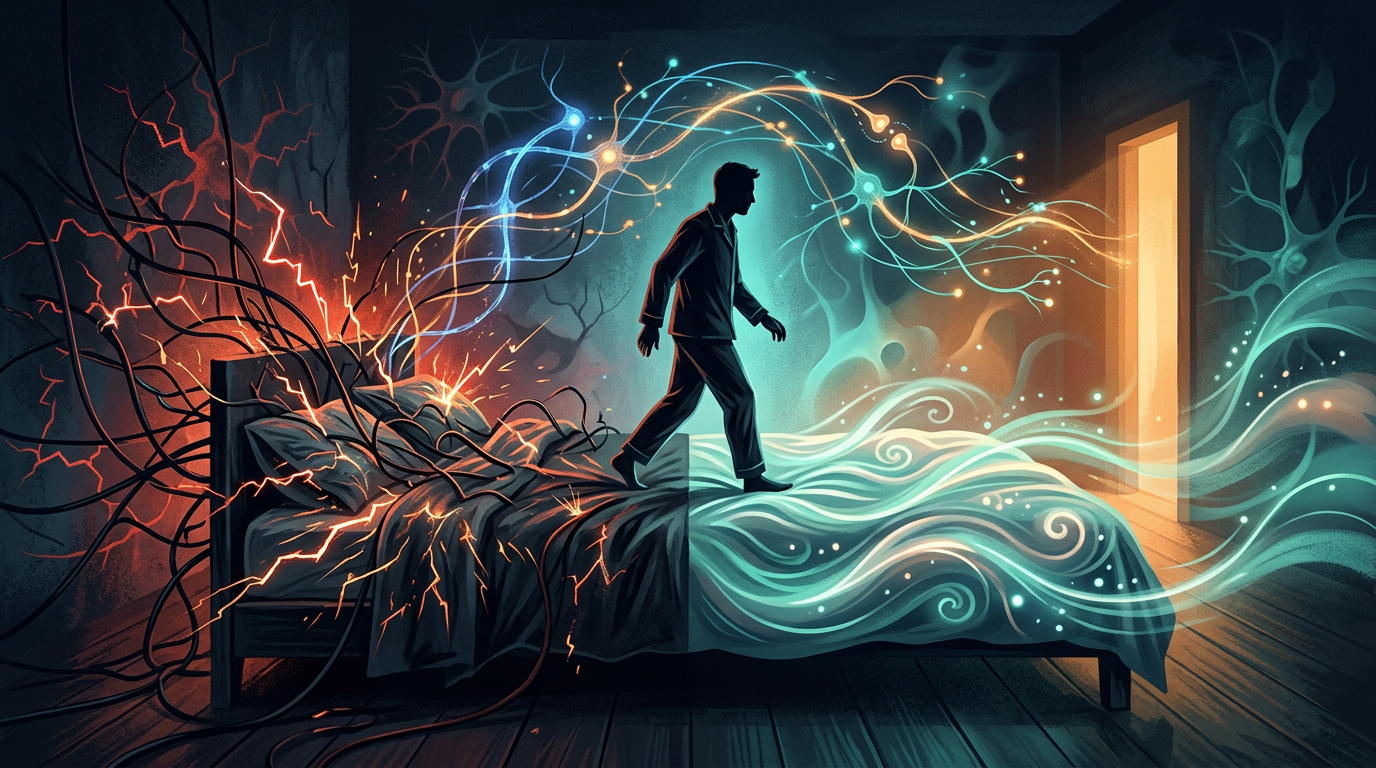
• Bed signals wakefulness, not sleep. Stimulus control breaks that association by strictly compartmentalizing: sleep only. Awake? Leave. • Get up after 15–20 minutes of wakefulness. Return only when drowsy. Consistency rebuilds the conditioned response over weeks, not days. • Fix wake time daily. No compensation sleep. Drives homeostatic pressure that makes stimulus control work. • Avoid clock-checking, screens, work, meals in bed. Each use reinforces competing associations. Clean stimulus context is the mechanism. • Hardest part: not staying in bed to "force it." That strengthens the problem. Get up and reset instead.
How Insomnia Wires the Brain
Chronic insomnia rewires the bed-sleep link. Months of nighttime worry, scrolling, clock-checking, or work emails in bed teach the brain that bed means alert. The bedroom becomes a conditional stimulus for arousal. By the time patients recognize the pattern, their amygdala activates at bedtime itself.
The Fix: Stimulus Control
Stimulus control is behavioral reconditioning, not willpower. The rules are strict and simple: use bed only for sleep and sex. Remove everything else—work, reading, screens, meals. Go to bed only when genuinely drowsy, not by the clock. If you are awake and frustrated after 15–20 minutes, get up. Move to a calm space with low light. Do something neutral (stretching, reading, listening to audio) until drowsiness returns. Then reset. Repeat as needed—sometimes multiple times per night.
Keep a fixed wake time every single day, weekends included. No compensation naps. This maintains sleep pressure and trains consistency.
Why It Works
Each time you leave the bed awake, you interrupt the conditioned arousal loop. Each time you return drowsy and fall asleep quickly, you reinforce the bed-sleep pairing. The mechanism is classical conditioning: extinguish the maladaptive association (bed→alert) and rebuild the adaptive one (bed→sleep). Consistency over weeks, not days, is required.
Common Failures
Staying in bed to "try harder" usually worsens insomnia—it adds performance anxiety and lengthens the bed-wake association. Clock-watching amplifies performance pressure and hypervigilance. Quitting after 3–4 nights defeats the extinction process. Most patients need 2–4 weeks of repeated practice before the sleep-bed link resets.
Bottom Line
The single most important move: when awake and frustrated, get up and leave. That one act is the entire mechanism.
For clinicians: deep diveMechanism, evidence, and clinical reasoning. Select to expand.
Stimulus Control Therapy in Chronic Insomnia: Mechanism, Evidence, and Clinical Application
Stimulus control therapy (SCT) remains one of the most empirically validated behavioral interventions for chronic insomnia, yet its mechanism is often misunderstood as volitional self-discipline rather than classical conditioning. In fact, SCT is grounded in Pavlovian learning theory and operates through extinction and discriminative stimulus reconditioning.
Theoretical Foundation: Bootzin's Model
Bootzin's stimulus control model (1972) posits that chronic insomnia develops when stimuli normally associated with sleep (the bed, bedroom) become conditional stimuli for wakefulness and arousal instead. In healthy sleep architecture, the bed functions as a strong discriminative stimulus: it signals a high probability of sleep. In chronic insomnia, especially in cases with significant performance anxiety or prolonged nighttime wakefulness, this stimulus-response pairing degrades. The bedroom becomes ambiguous or actively aversive—a context that triggers alertness, worry rehearsal, frustration, and physiological activation.
Bootzin proposed that the mechanism of stimulus control is re-establishment of the bed as a discriminative stimulus for sleep through selective pairing: the patient enters the bed environment only when already drowsy, and leaves immediately if wakefulness persists beyond a brief interval. This repeated pairing (bed + drowsiness → sleep) and non-pairing (bed + wakefulness → exit) re-trains the conditioned response.
The Extinction Component
Classical extinction learning is central here. When a conditioned stimulus (CS)—the bed—has been paired with an unconditioned stimulus (UCS) of arousal and frustration, that CS acquires the power to elicit arousal autonomously. Over time, the bed itself becomes a cue that triggers wakefulness, even before sleep-disruptive cognition occurs. Stimulus control forces repeated trials in which the bed-arousal pairing is not reinforced: the patient is instructed to leave before the pairing can consolidate further.
Each nighttime departure breaks the reinforcement schedule. Extinction does not erase the learned association instantly; it requires repeated non-reinforced exposure. Research on extinction learning shows that variability in reinforcement and spacing of trials enhance long-term retention of the new (adaptive) response (Morin et al., 1994). This is why stimulus control requires consistent application over weeks, and why sporadic use or premature termination often fails.
Conditioned Arousal and Hyperarousal
In chronic insomnia, especially in populations with high neuroticism or anxiety sensitivity, the bed can become a conditioned elicitor of the full arousal response: sympathetic activation, cortical hyperarousal (elevated EEG beta and gamma bands), intrusive thoughts, and a heightened sense of performance pressure. The mere act of lying down can trigger this cascade. This is not deconditioning easily with reassurance or exposure; it requires behavioral architecture that prevents reinforcement of the bed-arousal link.
Stimulus control does this by ensuring that the arousal state itself never co-occurs with the bed for prolonged periods. The rule "leave after 15–20 minutes of wakefulness" is not arbitrary; it reflects the time window in which learned associations consolidate within a single night. Staying in bed longer only strengthens the association between lying down and physiological arousal.
Fixed Wake Time: The Homeostatic Driver
A critical and often underappreciated component of stimulus control is the rigid wake time. This maintains sleep homeostasis and creates the necessary sleep pressure that makes the protocol effective. Variable wake times and compensatory naps flatten sleep pressure, reducing the probability that the patient will enter the bed already drowsy—the foundational requirement for stimulus control to work.
Fixed wake time also creates a form of constraint-induced learning: over time, as sleep pressure accumulates and the bed-sleep association is selectively reinforced (bed only when drowsy), the threshold for sleep onset naturally lowers. This is not willpower; it is homeostatic regulation meeting a repaired conditional stimulus.
Clinical Reasoning and Adherence
The main clinical challenge is explaining why staying in bed to "try harder" is contraindicated. Patients often interpret getting out of bed as "giving up" or "losing sleep." The physician's role is to reframe the behavior: leaving the bed is active treatment. Each departure is a training trial. The mechanism is extinction and reconditioning, not compensation or defeat.
Adherence also improves when the timeline is realistic. Most patients require 2–4 weeks of consistent application before measurable improvement. Premature termination is a leading cause of failure (Morin et al., 2009). Setting this expectation upfront reduces dropout and false failures.
Evidence Base
Stimulus control has moderate-to-large effect sizes in randomized controlled trials and is recommend as first-line behavioral therapy by the American Academy of Sleep Medicine (Schutte-Rodin et al., 2008). Meta-analyses show that it is particularly effective in populations with secondary insomnia and high conditioned arousal, and it generalizes well across age groups and comorbidities.
Conclusion
Stimulus control is not a willpower-based hack; it is applied classical conditioning. The mechanism is selective reinforcement of the bed-sleep pairing and extinction of the bed-arousal pairing. Fixed wake time maintains homeostatic pressure. Consistency is the active ingredient. For the patient, the locus of control is clear: when frustrated and awake, get up and reset. That single move is the entire intervention.
- Bootzin, R. R. (1972). "Stimulus control treatment for insomnia." Proceedings of the American Psychological Association, 7, 395–396.
- Morin, C. M., Culbert, J. P., & Schwartz, S. M. (1994). "Nonpharmacological interventions for insomnia: a meta-analysis of treatment efficacy." American Journal of Psychiatry, 151(8), 1172–1180.
- Morin, C. M., Bootzin, R. R., Buysse, D. J., Edinger, J. D., Espie, C. A., & Lichstein, K. L. (2006). "Psychological and behavioral treatment of insomnia: update of the recent evidence (1998–2004)." Sleep, 29(11), 1398–1414.
- Schutte-Rodin, S., Broch, L., Buysse, D., Dorsey, C., & Sateia, M. (2008). "Clinical guideline for the evaluation and management of chronic insomnia in adults." Journal of Clinical Sleep Medicine, 4(5), 487–504.